
Climbing, Healing & the Mountains
A veteran’s journey through Estes Park & Rocky Mountain National Park
The expansive views and broad summit of Longs Peak provide peace and tranquility after experiencing the visceral violence of combat. Over the years, the tallest peak in Rocky Mountain National Park (RMNP), standing at 14,259 feet, hasn’t fixed me, but it has healed me in its own way. The vast open spaces of the Rockies can be the antidote to the closed, cluttered, threat-saturated environments of combat—the horizon actually leads somewhere safe. RMNP is sacred ground for me, filled with natural cathedrals that restore a sense of scale and perspective when my mind is overwhelmed with negative thoughts or lingering feelings of resentment and guilt. The physical exhaustion from a big alpine objective quiets the noise in a way few other things can.
When I retired after twenty-five years of service, I was confronted with a loss of mission, purpose, and camaraderie. Few vocations like being a professional soldier can provide those qualities, and once you’ve attained them, they leave a significant void after they’re gone. I’ve been fortunate to find healthy replacement activities in the Rocky Mountains, with climbing being one of the most important to my mental health. I’ve replaced combat and combat training with a different mission, which has helped give me a life worth living. The summit is now my goal, and the climbing team is my new unit. The familiarity with planning, equipment management, route finding, communication, weather, and exposure to controlled danger all feels natural and reassuring. I’ve discovered a way to embrace nostalgia without living in the past, and I’ve found it on exposed rock walls with fellow veterans. I returned from combat wounded and broken in many ways, but now I am able to come back from the mountains closer to whole and feeling more healed.
There is an equally important void many of us experience following our service—beyond mission and purpose—and that is community. Those who have served in combat develop a bond with their fellow service members that cannot be fully replicated in civilian life. I had the privilege of serving in several storied infantry and Army Special Operations units, including the 10th Mountain Division and the 75th Ranger Regiment. The 10th Mountain Division has a literal mountaineering legacy, and the symmetry of returning to high terrain as a veteran was very powerful. The Regiment’s culture is built on elite teamwork, the highest standards, and mission focus. After retirement, it was daunting to find something that could fill both the physical and personal space in my life. Fortunately, my travels led me to Estes Park, Colorado, where I crossed paths with another Global War on Terror (GWOT) veteran named Adam.
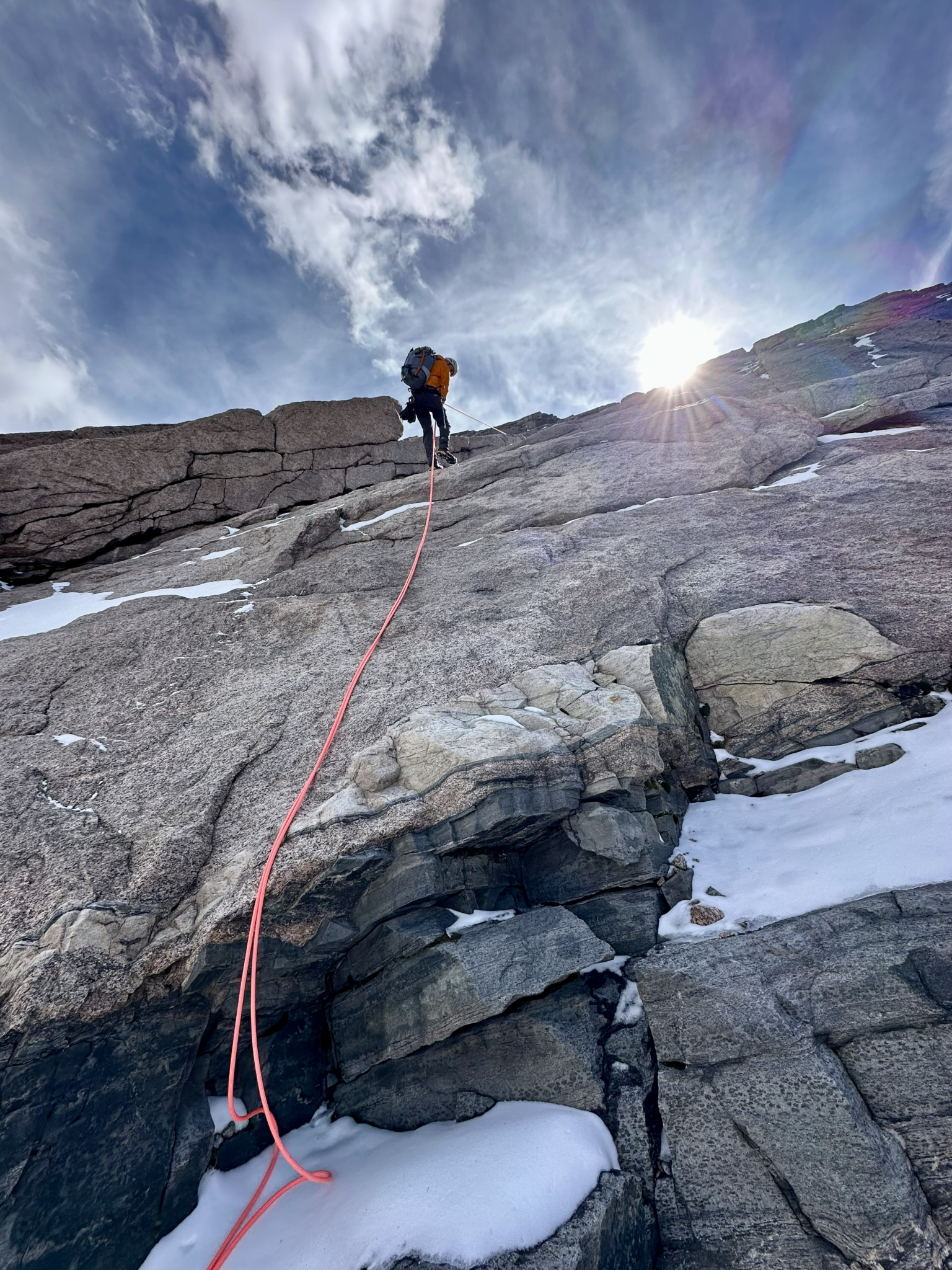
There’s something that can’t be replicated between two people who’ve been downrange—you don’t have to explain hypervigilance, the scanning, or the weight behind the eyes. Shared suffering in the mountains echoes shared suffering in combat but with a redemptive outcome. Over the past several years, Adam and I have spent many days testing our mind, body, and spirit on Longs Peak in different seasons and conditions. Although the routes have varied in difficulty and outcome, the therapeutic healing found in long days with a fellow veteran has been consistent. This connection is vital for veterans who come home from combat feeling unseen. Adam and I always see and hear each other, even if it’s just bitching and complaining about the conditions.
Beyond peer connection, Adam and I have discovered something else in our explorations of Longs Peak. Because we have deliberately chosen to ascend and descend various routes under conditions from clear blue skies to rowdy weather, we’ve developed high alpine problem-solving skills and techniques. Our multiple summits via different routes reflect something veterans inherently understand: same goal, different approach, new lessons each time. PACE planning—having an established primary, alternate, contingency, and emergency plan—is standard operating procedure in the units I served in, and Adam and I have found that our shared combat experiences translate very effectively to the environments we explore in our backyard. In this way, our traumas can serve our healing. The mountain also demands full commitment and respect every time—regardless of rank, background, trauma, or past achievements. It strips away ego in a healthy way. It challenges you by exposing your vulnerability through grueling physical exertion and nervous system adaptation to managed risk, creating spaces for authentic exchanges among climbers. These intimate moments paradoxically become safe places where combat veterans feel comfortable sharing feelings and experiences they might rarely discuss otherwise.
My experiences in gym, sport, and trad climbing as a combat veteran inspired me to serve through the Vertical Healing Rock Climbing Program, developed by the Combat Recovery Foundation. Vertical Healing welcomes veterans and first responders of all experience levels and backgrounds, supported by the Estes Park Mountain Shop and KMAC Guides. The mountains existed long before the war, and they’ll outlast it—there’s room for you on the trail.