
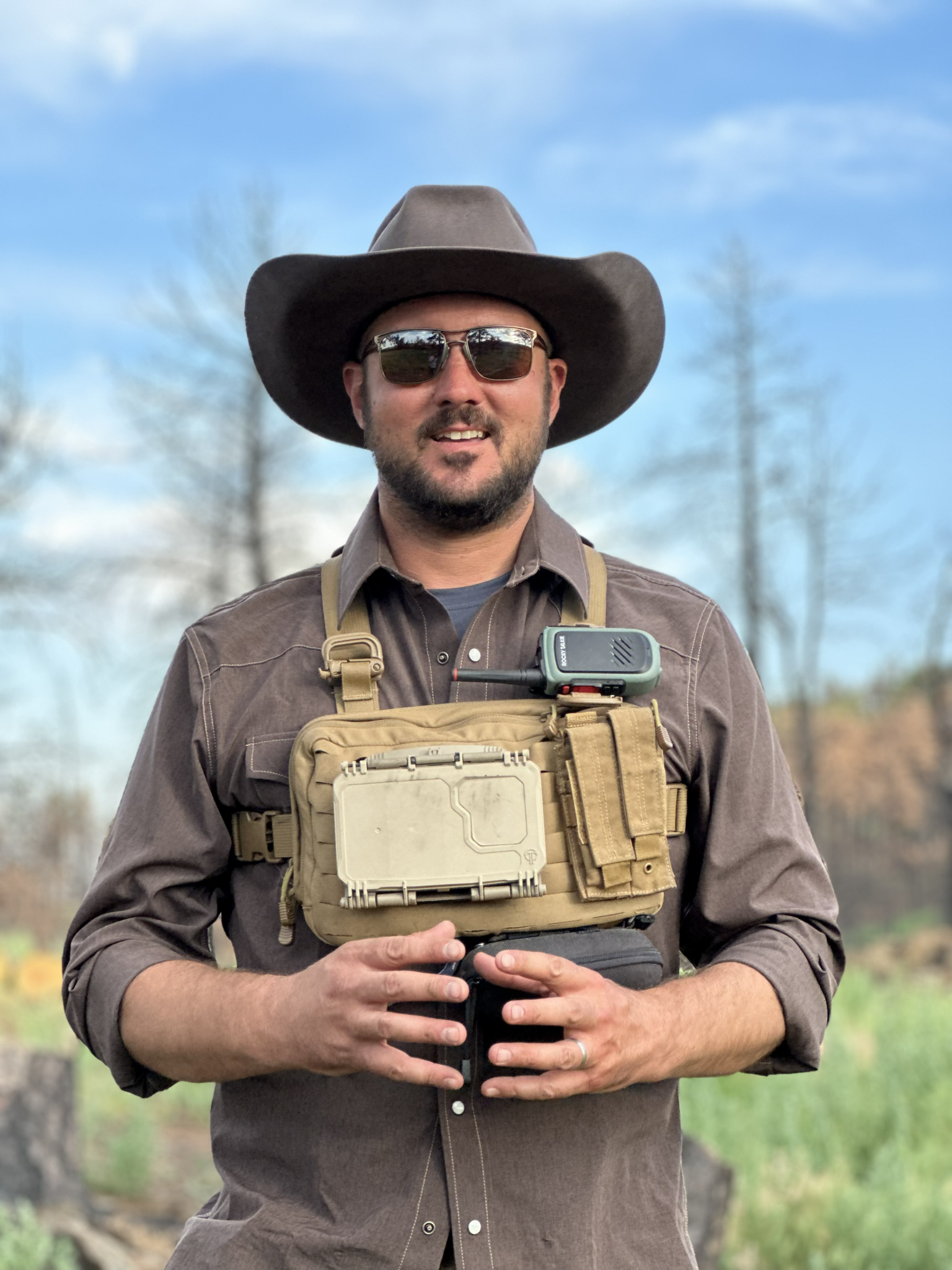
Combat Cred
Events define and guide a life. In Marshall Spring’s life, those events (not listed in chronological order) include:
- Hearing a disgruntled combat vet on a phone call assume Combat Recovery Foundation (CRF) is just another ineffective suicide-prevention non-profit led by people who have never seen battle, and
- Exposing himself to enemy fire to try to rescue a fallen soldier, and
- Seeing what looks to be raindrop splatters on the sand near his feet actually being bullet splatters because enemy snipers barely missed their target – which was Marshall.
Those are three of countless events that make CRF Founder and Chief Executive Officer Marshall Spring who he is and determine what he does.
A disgruntled critic – Number 1 above
Since Marshall started CRF on Aug. 18, 2024, he has chosen a fairly low-visibility leadership role. “I knew I couldn’t do it alone or be the only face of the organization. I have intentionally recruited leaders who challenge my thoughts.”
But a recent phone call made him reassess at least temporarily that low-profile approach, which led to his request to be interviewed for this article, to be more open about his military background.
Several minutes into the critic’s call, Marshall asked, “What do you consider factors that make someone a combat veteran?” The caller quickly said, machine-gun style, “a Purple Heart, a Medal for Valor, or a Combat Action Ribbon.”
Marshall replied, “Oh, I have all three.” With that, the caller turned from critic to supporter. By the way, many CRF participants also meet that caller’s criteria.
You don’t have to be a combat veteran to lead or work for or volunteer or participate at CRF. But Marshall realizes it can be important for some people to know that he and others at CRF are battle-tested as they now fight to prevent suicide and other issues that impact veterans.
To know about Marshall’s younger days and how CRF formed, read the website personal profile titled “Time For Communities To Step It Up.” But to learn about Marshall, the combat vet, read on. First, a disclaimer from Marshall.
“I don’t want CRF to be about or reliant on me to exist. I possess a personal taboo around talking about events that could be considered heroic. It feels self-aggrandizing. I’m from the School of Quiet Professionalism. But by nature I’m a communicator and educator. Around the campfire, somebody has to advocate for peace. Maybe I’m a warrior/poet. I’m one of many who have walked this path of compassion alongside warrior. I have a hang-up about discussing what I’ve done but will do it if it lends credibility to what we’re trying to do at CRF,” says the communicator/educator.
Here are a few stories about Marshall the warrior. He was a Marine from 2002 to 2006. In those last two years he mainly worked in and around Ramadi, Iraq. Back then and there, it was not a drill. It was war. The Iraq War – which lasted from 2003 to 2011.
He trained to be and served as a canine handler. A civilian might think, “Oh, how sweet, he got to hang out with ‘man’s best friend.’” Wait, the formal title is “Explosive Detection Dog Handler.” Hmm, that puts a much different spin to the gig. Stay tuned to learn more about the value of and danger to a “canine handler” in a war-torn country.
Exposing yourself to enemy fire – Number 2 above
Marshall joined a team hunting for Abu Musab al-Zarqawi, the founding leader of Al-Qaeda in Iraq. One day Marshall’s team occupied a partial building that served as a “choke point” (or bottleneck). Another canine handler and Marshall had just left the building when it came under attack and they bolted back into the building. During the fight, Marshall saw a wounded soldier on the ground outside. Instinct kicked in and Marshall ran to the man and dragged him into the building while gunfire roared. It was an Iraqi soldier, who probably was already dead when Marshall got him inside.
“You find out who you are because nothing is more truthful and surreal at the same time than combat,” Marshall says. “When I ‘woke up’ surrounded by dead bodies and bullet casings, I found out I exposed myself to fire to help save a man who was an enemy. I had no regard for my own safety. I think there are a lot of people who would want to do that but not everybody possesses the will. I’m glad I have an internal machine or drive to take such an action.”
For his valiant and generous effort in the maelstrom of violence, Marshall received a Navy and Marine Corps Achievement Medal.
What looks to be raindrops on the sand – Number 3 above
Marshall was part of a team transporting General James (“Mad Dog”) Mattis when the lead vehicle was hit by an Improvised Explosive Device (IED). The poet/warrior was in that vehicle and lost consciousness for a while. When Marshall started to wake up, still groggy and confused, he stood up and noticed what looked to be raindrops splattering the sand near his feet. That would be a nice image for a future piece to write, Marshall the poet might have thought. Then he started to go look for his dog when a team doctor grabbed him and pulled him behind the damaged vehicle.
Those were enemy bullets, not raindrops, scattering the sand.
Marshall and his comrades weren’t having a bad day at the office; they were walking that shaky tightrope between life on one side and death on the other.
The dangers of canine duty
So what is the major responsibility of a canine handler and the dog? The answer dwells in the formal name: “Explosive Detection.” This job title would garner few applicants in the everyday world.
In the military, Marshall explains, there are about four support roles for every war fighter. He played a “support” role. “My job was to protect war fighters, especially from IEDs. If an infantry unit wanted to do a patrol and move on an objective, I would walk in front of them with the dog.” (Writer’s note: Um, that’s BIGTIME “support.”)
Marshall recalls: “I knew we were close to a bomb when the dog’s head would start moving up and around. I had to get as close to the IED as possible.” Once the patrol had moved away, he would detonate the explosive. How? “Usually I would place a grenade near the IED, back away and then shoot the grenade,” Marshall says. If time permitted, Marshall could call in experts from Explosive Ordinance Disposal (EOD), which sent people with bomb suits and robots.
How rare is it to be an Explosive Detection Dog Handler in a war zone? Out of curiosity, Marshall recently plugged in job information to an AI program to discover it was more likely to be hit by lightning three times than to have that wartime job.
Well, he avoided lightning and a fatal gunshot, even though canine handlers have a special target on their back. Huh? Iraqi snipers were similar in some ways to bounty hunters of the Old West. They got extra pay for kill shots on certain people, especially officers … and canine handlers. But from afar, it could be difficult to spot who was an officer. But to spot a canine handler, look for the dude by the dog. Yet another reason to consider Marshall a true combat veteran who put his life on the line and has the credibility to lead a veterans’ organization.
Distant memories
“I found a lot of explosives and weapons caches in Iraq and received medals for those actions,” Marshall says with humility. “I recently found a briefcase filled with after-action reports, written by other people. My name was in those reports. I don’t talk about Iraq much and the reports made me realize I don’t remember a lot about my time there.”
But the reports did remind him of the time one other Marine joined he and his dog to rush a building to take out a sniper. And the time a mortar landed on a roof of a building they were in. It didn’t detonate, so Marshall climbed to the roof and hurled the potentially deadly explosive away from the building.
A thick 3-ring binder holds and describes many Achievement Medals along with his Purple Heart. He rarely looks at the binder and mainly tries to forget his Iraqi experiences.
Those medals and citations came with a price that Marshall still pays to this day for his wartime wounds. “I am in constant pain that I can’t ignore,” he says. “I have severe muscle atrophy in my right arm because of injuries to my head and neck. I have trouble sleeping.” Those are some of the physical battle wounds. What about other “wounds?”
Marshall adds: “I also have trauma-induced Attention Deficit Disorder, severe Post-Traumatic Stress Disorder, and chronic suicidality.”
The CRF founder’s actions in Iraq were heroic. Alas, some heroes retire from heroics once they leave the battlefield behind. But other heroes find ways to serve greater needs for a greater number of people for a greater amount of time. Though his wounds remain, Marshall – the warrior/poet/communicator/educator – is the latter kind of hero.
Willing to open up
For one afternoon, to answer questions for this one article, Marshall told war stories, to enhance his credibility as the leader among many other CRF leaders.
What are takeaways Marshall wants veterans unfamiliar with CRF to get from this article?
- CRF is an organization founded by vets for vets.
- CRF serves veterans authentically so they feel seen, heard and empowered.
- CRF participants courageously strive to become who and what they want to become.
- CRF offers a platform to help them achieve their goals.
- If they join the CRF community they will have options for how to help themselves and, if they choose, help others.
What does Marshall hope potential donors sense from this article?
- You can help empower people who signed on the dotted line to risk their lives and protect this nation and its citizens.
- Your commitment can support veterans who intimately know about life-on-the-line commitment.
- Your gift will help those involved with CRF feel connected and valued.
The end … of the beginning
CRF is still an organizational infant. But it’s off to a great start with more than 1,000 veterans (some who saw combat) already served and 60 volunteers who help fuel CRF events and programs. Marshall leads a paid staff (all vets) of four, including himself.
For many of those 1,000+ veterans, their service brought them the best of times … and the worst of times. It’s been said that to know me you must “walk a mile in my shoes.” CRF leaders have figuratively marched miles in your boots.
The people of CRF know firsthand about the worst of times and now band together to collectively build what they hope becomes the best of times. Marshall stands ready to help lead that charge.
“Like many people, at times thought I had nothing unique or special to offer,” Marshall says. “I’m lucky that for some reason I’m uncomfortable falling short of the best version of myself. When I left the Marines I struggled with ‘survivor’s guilt.’ As a Marine I had the ability to take bombs out of the equation, to reduce danger to others. Now I have the opportunity, with the help of many others, to prevent suicides.”
Marshall pauses a moment. He peers into his future and sees clearly his task. “I need to do suicide prevention because,” he pauses again, “I’m good at it.”
Thankfully, CRF staff members and volunteers under Marshall’s leadership are good at it, too.
And that’s a good thing for all of us.